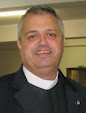
When I left the meeting of the Rotary Club of Goose Creek this afternoon I had a message from Karen Griffin and suspected, correctly, that the news was sad, namely that her husband, the Rev'd Canon Dr. Will Griffin, had passed away -- he indeed had the previous night.
Will Griffin and I first corresponded via email before finally meeting in person at the annual Mere Anglicanism conference in Charleston in, I believe, 2006. At the time Will, whose earthly pilgrimage had included time as an Old Catholic as well as Roman Catholic (with a stint as a monk) in addition to time in the Episcopal Church before heading for the Continuum, was a priest in the Anglican Province of America and fairly recently widowed. We struck up a friendship and some time after that he married Karen, who brought him great joy. Will's service on the board of the Federation of Anglican Churches in the Americas brought him to Charleston with increasing frequency and we often enjoyed getting together -- in between those meetings we would keep up by telephone and email. When a large number of parishes left the APA to form the Diocese of the West of the Reformed Episcopal Church and later of the Anglican Church in North America and added benefit was that I got to visit with him more regularly. At the enthronement of Archbishop Robert Duncan, we processed together.
Will lived a full life in service to Christ and His Church. May he rest in peace and rise in glory!
Wednesday, May 11, 2011

Sunday, April 10, 2011
The Fifth Sunday in Lent, commonly called Passion Sunday.
WE beseech thee, Almighty God, mercifully to look upon thy people; that by thy great goodness they may be governed and preserved evermore, both in body and soul; through Jesus Christ our Lord. Amen.
The Epistle. Hebrews 9:11-15 (ESV)
But when Christ appeared as a high priest of the good things that have come, then through the greater and more perfect tent (not made with hands, that is, not of this creation) he entered once for all into the holy places, not by means of the blood of goats and calves but by means of his own blood, thus securing an eternal redemption. For if the blood of goats and bulls, and the sprinkling of defiled persons with the ashes of a heifer, sanctify for the purification of the flesh, how much more will the blood of Christ, who through the eternal Spirit offered himself without blemish to God, purify our conscience from dead works to serve the living God.
Therefore he is the mediator of a new covenant, so that those who are called may receive the promised eternal inheritance, since a death has occurred that redeems them from the transgressions committed under the first covenant.
The Gospel. St. John 8:46-51
Which one of you convicts me of sin? If I tell the truth, why do you not believe me? Whoever is of God hears the words of God. The reason why you do not hear them is that you are not of God.”
Before Abraham Was, I Am
The Jews answered him, “Are we not right in saying that you are a Samaritan and have a demon?” Jesus answered, “I do not have a demon, but I honor my Father, and you dishonor me. Yet I do not seek my own glory; there is One who seeks it, and he is the judge. Truly, truly, I say to you, if anyone keeps my word, he will never see death.” The Jews said to him, “Now we know that you have a demon! Abraham died, as did the prophets, yet you say, ‘If anyone keeps my word, he will never taste death.’ Are you greater than our father Abraham, who died? And the prophets died! Who do you make yourself out to be?” Jesus answered, “If I glorify myself, my glory is nothing. It is my Father who glorifies me, of whom you say, ‘He is our God.’ But you have not known him. I know him. If I were to say that I do not know him, I would be a liar like you, but I do know him and I keep his word. Your father Abraham rejoiced that he would see my day. He saw it and was glad.” So the Jews said to him, “You are not yet fifty years old, and have you seen Abraham?” Jesus said to them, “Truly, truly, I say to you, before Abraham was, I am.” So they picked up stones to throw at him, but Jesus hid himself and went out of the temple.
Sunday, April 3, 2011
The Fourth Sunday in Lent
The Collect.
G
RANT, we beseech thee, Almighty God, that we, who for our evil deeds do worthily deserve to be punished, by the comfort of thy grace may mercifully be relieved; through our Lord and Saviour Jesus Christ.Amen.
The Epistle. Galatians 4:21-31 (ESV)
Tell me, you who desire to be under the law, do you not listen to the law? For it is written that Abraham had two sons, one by a slave woman and one by a free woman. But the son of the slave was born according to the flesh, while the son of the free woman was born through promise. Now this may be interpreted allegorically: these women are two covenants. One is from Mount Sinai, bearing children for slavery; she is Hagar. Now Hagar is Mount Sinai in Arabia; she corresponds to the present Jerusalem, for she is in slavery with her children. But the Jerusalem above is free, and she is our mother. For it is written,
“Rejoice, O barren one who does not bear;
break forth and cry aloud, you who are not in labor!
For the children of the desolate one will be more
than those of the one who has a husband.”
Now you, brothers, like Isaac, are children of promise. But just as at that time he who was born according to the flesh persecuted him who was born according to the Spirit, so also it is now. But what does the Scripture say? “Cast out the slave woman and her son, for the son of the slave woman shall not inherit with the son of the free woman.” So, brothers, we are not children of the slave but of the free woman.
The Gospel. St. John 6:1-14 (ESV)
After this Jesus went away to the other side of the Sea of Galilee, which is the Sea of Tiberias. And a large crowd was following him, because they saw the signs that he was doing on the sick. Jesus went up on the mountain, and there he sat down with his disciples. Now the Passover, the feast of the Jews, was at hand. Lifting up his eyes, then, and seeing that a large crowd was coming toward him, Jesus said to Philip, “Where are we to buy bread, so that these people may eat?” He said this to test him, for he himself knew what he would do. Philip answered him, “Two hundred denarii would not buy enough bread for each of them to get a little.” One of his disciples, Andrew, Simon Peter's brother, said to him, “There is a boy here who has five barley loaves and two fish, but what are they for so many?” Jesus said, “Have the people sit down.” Now there was much grass in the place. So the men sat down, about five thousand in number. Jesus then took the loaves, and when he had given thanks, he distributed them to those who were seated. So also the fish, as much as they wanted. And when they had eaten their fill, he told his disciples, “Gather up the leftover fragments, that nothing may be lost.” So they gathered them up and filled twelve baskets with fragments from the five barley loaves left by those who had eaten. When the people saw the sign that he had done, they said, “This is indeed the Prophet who is to come into the world!”
Sunday, March 27, 2011
The Third Sunday in Lent
The Collect.
WE beseech thee, Almighty God, look upon the hearty desires of thy humble servants, and stretch forth the right hand of thy Majesty, to be our defence against all our enemies; through Jesus Christ our Lord.Amen.
The Epistle. Ephesians 5:1-14 (ESV)
Therefore be imitators of God, as beloved children. And walk in love, as Christ loved us and gave himself up for us, a fragrant offering and sacrifice to God.
But sexual immorality and all impurity or covetousness must not even be named among you, as is proper among saints. Let there be no filthiness nor foolish talk nor crude joking, which are out of place, but instead let there be thanksgiving. For you may be sure of this, that everyone who is sexually immoral or impure, or who is covetous (that is, an idolater), has no inheritance in the kingdom of Christ and God. Let no one deceive you with empty words, for because of these things the wrath of God comes upon the sons of disobedience. Therefore do not become partners with them; for at one time you were darkness, but now you are light in the Lord. Walk as children of light (for the fruit of light is found in all that is good and right and true), and try to discern what is pleasing to the Lord. Take no part in the unfruitful works of darkness, but instead expose them. For it is shameful even to speak of the things that they do in secret. But when anything is exposed by the light, it becomes visible, for anything that becomes visible is light. Therefore it says,
“Awake, O sleeper,
and arise from the dead,
and Christ will shine on you.”
The Gospel. St. Luke 11:14-28 (ESV)
Now he was casting out a demon that was mute. When the demon had gone out, the mute man spoke, and the people marveled. But some of them said, “He casts out demons by Beelzebul, the prince of demons,” while others, to test him, kept seeking from him a sign from heaven. But he, knowing their thoughts, said to them, “Every kingdom divided against itself is laid waste, and a divided household falls. And if Satan also is divided against himself, how will his kingdom stand? For you say that I cast out demons by Beelzebul. And if I cast out demons by Beelzebul, by whom do your sons cast them out? Therefore they will be your judges. But if it is by the finger of God that I cast out demons, then the kingdom of God has come upon you. When a strong man, fully armed, guards his own palace, his goods are safe; but when one stronger than he attacks him and overcomes him, he takes away his armor in which he trusted and divides his spoil. Whoever is not with me is against me, and whoever does not gather with me scatters.
“When the unclean spirit has gone out of a person, it passes through waterless places seeking rest, and finding none it says, ‘I will return to my house from which I came.’ And when it comes, it finds the house swept and put in order. Then it goes and brings seven other spirits more evil than itself, and they enter and dwell there. And the last state of that person is worse than the first.”
Sunday, March 13, 2011
Of Church Bookshops and Literature Tables
A friend of mine alerted me to the fact that Christian Book Distributors felt compelled to put a "theological warning" on Rob Bell's forthcoming book Love Wins. I must confess that I'm not that familiar with the Rev'd Mr. Bell, preferring to get my theology, as I often like to say, from old dead white guys, but Love Wins has generated considerable theological controversy as Bell seems to be friendly toward Universalism -- hence the warning. As my friend pointed out, CBD has not felt compelled to issue such theological warnings while selling other books -- by Joel Osteen, Joyce Meyer, and Jim Wallis for example -- that are cause for at least as much concern. It would appear that CBD is engaging in a bit of selective orthodoxy.
That's not terribly surprising. Years ago during seminary I briefly worked for a Christian bookstore and it was a depressing experience. I actually felt dirty selling some of the questionable stuff that was carried (in the half of the store that actually carried books and wasn't devoted to Jesus junk) and, if I had to do it over again, would learn bartending as doing so wouldn't feel as compromising (it could also serve as a great counseling practicum, but that's another story). The fact of the matter is that most of "Christian retail" is more retail than Christian with a few happy exceptions (Cumberland Valley Bible Book Service is one, as is Lifeway for the most part, owing to its affiliation with the Southern Baptist Convention) but many of them sell all sorts of things in pursuit of profits.
I've long been a fan of bookshops run by churches. The Cathedral Church of St. Luke and St. Paul, where I'm privileged to assist, formerly had an excellent one and it is missed. The First Presbyterian Church in Columbia, South Carolina, has a great one as does the Independent Presbyterian Church of Savannah, Georgia, and St. Helena's Episcopal Church in Beaufort, South Carolina; if you live near those areas or find yourself visiting them I would warmly commend them to you (they are strong churches as well). The First Presbyterian Churches of Augusta and Macon, Georgia, used to have great ones; I've not been to to former one in years and understand that the latter has closed. Because they're underwritten by the churches and don't have the overhead of larger, mall-based ventures, such bookshops can exercise more quality control than those run purely as a business. That having been said, it's usually only larger churches that have the resources to operate such ventures.
Because Christian literature is so important, every church should consider providing quality literature (the emphasis is on quality -- the ubiquitous Chick Tracts have probably done more harm than good through the years!) either for sale or for free. While not every church can afford to run a full-blown bookshop, every church can have a table with some literature on it for the edification of its members and visitors. When I have been in charge of parishes, that's one of the first things that I've done and it reaped great results.
The following are a few ideas for this:
Chapel Library: The literature of Mt. Zion Bible Church, a smallish (80 members, about twice what they were roughly ten years ago) essentially (nut not officially) Reformed Baptist church in Pensacola, Florida. They have reprinted quite a few sermons and tracts by greats such as J.C. Ryle, Charles Spurgeon, and Robert Murray M'Cheyne. Their literature is free in reasonable quantities, for larger quantities it is provided at cost although, obviously, donations are accepted. I've been receiving their stuff for years and have benefited greatly by it.
The Banner of Truth Trust: This publishing house has done yoeman's work in reprinting classic and new literature from a Reformed and Evangelical perspective since 1957. While their books priced at various levels, they have some short booklets that are immensely practical and inexpensive enough to give away.
P&R Publishing: Formerly also known a Presbyterian and Reformed Publishing (I'm not entirely sure of why they shortened it), their books are priced at various levels, but they publish very helpful pamphlets by the Rev'd Dr. Jay E. Adams that, at $25 for a pack of 100, are within the price range of almost all congregations to give away.
Publish Your Own: With modern technology and the ease of desktop publishing, publishing short pamphlets on timely subjects is well within reach of many clergy and churches.
I hope that more churches will begin or expand their literature ministries.
That's not terribly surprising. Years ago during seminary I briefly worked for a Christian bookstore and it was a depressing experience. I actually felt dirty selling some of the questionable stuff that was carried (in the half of the store that actually carried books and wasn't devoted to Jesus junk) and, if I had to do it over again, would learn bartending as doing so wouldn't feel as compromising (it could also serve as a great counseling practicum, but that's another story). The fact of the matter is that most of "Christian retail" is more retail than Christian with a few happy exceptions (Cumberland Valley Bible Book Service is one, as is Lifeway for the most part, owing to its affiliation with the Southern Baptist Convention) but many of them sell all sorts of things in pursuit of profits.
I've long been a fan of bookshops run by churches. The Cathedral Church of St. Luke and St. Paul, where I'm privileged to assist, formerly had an excellent one and it is missed. The First Presbyterian Church in Columbia, South Carolina, has a great one as does the Independent Presbyterian Church of Savannah, Georgia, and St. Helena's Episcopal Church in Beaufort, South Carolina; if you live near those areas or find yourself visiting them I would warmly commend them to you (they are strong churches as well). The First Presbyterian Churches of Augusta and Macon, Georgia, used to have great ones; I've not been to to former one in years and understand that the latter has closed. Because they're underwritten by the churches and don't have the overhead of larger, mall-based ventures, such bookshops can exercise more quality control than those run purely as a business. That having been said, it's usually only larger churches that have the resources to operate such ventures.
Because Christian literature is so important, every church should consider providing quality literature (the emphasis is on quality -- the ubiquitous Chick Tracts have probably done more harm than good through the years!) either for sale or for free. While not every church can afford to run a full-blown bookshop, every church can have a table with some literature on it for the edification of its members and visitors. When I have been in charge of parishes, that's one of the first things that I've done and it reaped great results.
The following are a few ideas for this:
Chapel Library: The literature of Mt. Zion Bible Church, a smallish (80 members, about twice what they were roughly ten years ago) essentially (nut not officially) Reformed Baptist church in Pensacola, Florida. They have reprinted quite a few sermons and tracts by greats such as J.C. Ryle, Charles Spurgeon, and Robert Murray M'Cheyne. Their literature is free in reasonable quantities, for larger quantities it is provided at cost although, obviously, donations are accepted. I've been receiving their stuff for years and have benefited greatly by it.
The Banner of Truth Trust: This publishing house has done yoeman's work in reprinting classic and new literature from a Reformed and Evangelical perspective since 1957. While their books priced at various levels, they have some short booklets that are immensely practical and inexpensive enough to give away.
P&R Publishing: Formerly also known a Presbyterian and Reformed Publishing (I'm not entirely sure of why they shortened it), their books are priced at various levels, but they publish very helpful pamphlets by the Rev'd Dr. Jay E. Adams that, at $25 for a pack of 100, are within the price range of almost all congregations to give away.
Publish Your Own: With modern technology and the ease of desktop publishing, publishing short pamphlets on timely subjects is well within reach of many clergy and churches.
I hope that more churches will begin or expand their literature ministries.
The First Sunday in Lent.
The Collect.
O LORD, who for our sake didst fast forty days and forty nights; Give us grace to use such abstinence, that, our flesh being subdued to the Spirit, we may ever obey thy godly motions in righteousness, and true holiness, to thy honour and glory, who livest and reignest with the Father and the Holy Ghost, one God, world without end. Amen.
The Epistle. 2 Corinthians 6:1-10 (ESV)
Working together with him, then, we appeal to you not to receive the grace of God in vain. For he says,
“In a favorable time I listened to you,
and in a day of salvation I have helped you.”
Behold, now is the favorable time; behold, now is the day of salvation. We put no obstacle in anyone's way, so that no fault may be found with our ministry, but as servants of God we commend ourselves in every way: by great endurance, in afflictions, hardships, calamities, beatings, imprisonments, riots, labors, sleepless nights, hunger; by purity, knowledge, patience, kindness, the Holy Spirit, genuine love; by truthful speech, and the power of God; with the weapons of righteousness for the right hand and for the left; through honor and dishonor, through slander and praise. We are treated as impostors, and yet are true; as unknown, and yet well known; as dying, and behold, we live; as punished, and yet not killed; as sorrowful, yet always rejoicing; as poor, yet making many rich; as having nothing, yet possessing everything.
The Gospel. St. Matthew 4:1-11 (ESV)
Then Jesus was led up by the Spirit into the wilderness to be tempted by the devil. And after fasting forty days and forty nights, he was hungry. And the tempter came and said to him, “If you are the Son of God, command these stones to become loaves of bread.” But he answered, “It is written,
“‘Man shall not live by bread alone,
but by every word that comes from the mouth of God.’”
Then the devil took him to the holy city and set him on the pinnacle of the temple and said to him, “If you are the Son of God, throw yourself down, for it is written,
“‘He will command his angels concerning you,’
and
“‘On their hands they will bear you up,
lest you strike your foot against a stone.’”
Jesus said to him, “Again it is written, ‘You shall not put the Lord your God to the test.’” Again, the devil took him to a very high mountain and showed him all the kingdoms of the world and their glory. And he said to him, “All these I will give you, if you will fall down and worship me.” Then Jesus said to him, “Be gone, Satan! For it is written,
“‘You shall worship the Lord your God
and him only shall you serve.’”
Then the devil left him, and behold, angels came and were ministering to him.
Sunday, March 6, 2011
The Sunday called Quinquagesima, or the next Sunday before Lent.
The Collect.
O LORD, who hast taught us that all our doings without charity are nothing worth; Send thy Holy Ghost, and pour into our hearts that most excellent gift of charity, the very bond of peace and of all virtues, without which whosoever liveth is counted dead before thee. Grant this for thine only Son Jesus Christ's sake. Amen.
The Epistle. 1 Corinthians 13:1-13 (ESV)
If I speak in the tongues of men and of angels, but have not love, I am a noisy gong or a clanging cymbal. And if I have prophetic powers, and understand all mysteries and all knowledge, and if I have all faith, so as to remove mountains, but have not love, I am nothing. If I give away all I have, and if I deliver up my body to be burned, but have not love, I gain nothing.Love is patient and kind; love does not envy or boast; it is not arrogant or rude. It does not insist on its own way; it is not irritable or resentful; it does not rejoice at wrongdoing, but rejoices with the truth. Love bears all things, believes all things, hopes all things, endures all things.
Love never ends. As for prophecies, they will pass away; as for tongues, they will cease; as for knowledge, it will pass away. For we know in part and we prophesy in part, but when the perfect comes, the partial will pass away. When I was a child, I spoke like a child, I thought like a child, I reasoned like a child. When I became a man, I gave up childish ways. For now we see in a mirror dimly, but then face to face. Now I know in part; then I shall know fully, even as I have been fully known.
So now faith, hope, and love abide, these three; but the greatest of these is love.
The Gospel. St. Luke 18:31-43 (ESV)
And taking the twelve, he said to them, “See, we are going up to Jerusalem, and everything that is written about the Son of Man by the prophets will be accomplished. For he will be delivered over to the Gentiles and will be mocked and shamefully treated and spit upon. And after flogging him, they will kill him, and on the third day he will rise.” But they understood none of these things. This saying was hidden from them, and they did not grasp what was said.
As he drew near to Jericho, a blind man was sitting by the roadside begging. And hearing a crowd going by, he inquired what this meant. They told him, “Jesus of Nazareth is passing by.” And he cried out, “Jesus, Son of David, have mercy on me!” And those who were in front rebuked him, telling him to be silent. But he cried out all the more, “Son of David, have mercy on me!” And Jesus stopped and commanded him to be brought to him. And when he came near, he asked him, “What do you want me to do for you?” He said, “Lord, let me recover my sight.” And Jesus said to him, “Recover your sight; your faith has made you well.” And immediately he recovered his sight and followed him, glorifying God. And all the people, when they saw it, gave praise to God.
Subscribe to:
Posts (Atom)